We are scientists making technology useful to our customers and reducing an accident to an incident

Why does DIPHOTERINE® solution not contain phosphate?

Whilst safe for the healthy eye, phosphate can cause calcification of the cornea when used on an injured eye. This risk, highlighted by several studies, is also recognised and documented by the European Medicines Agency (EMA), which emphasises that phosphate-based solutions for the healthy eye may pose a risk in the event of eye injury.

What are the properties of a solution containing phosphate?

A solution containing phosphate can act as a buffer. This property helps to limit fluctuations in pH when exposed to acidic or alkaline agents [1]. When used for eye irrigation, it can help to restore the pH of the ocular surface to a physiologically tolerable range, generally between 5.5 and 9.0.

However, upon contact with products containing calcium, such as cement or lime, or those containing iron or aluminium, or with calcium released from cells affected by acids or bases, phosphate ions may precipitate and cause side effects during chemical decontamination.

A brief history

The first phosphate-based solution was developed in the 1960s in Germany by Professor Thiel.

To date, the available clinical data do not demonstrate the efficacy of phosphate buffer solutions for chemical decontamination. However, several studies published since the 2000s have highlighted risks associated with their use on damaged tissue.

What happens when phosphate is used on an injured eye

Phosphate-containing irrigation solutions can be used safely on healthy eyes, but as soon as a chemical enters the eye, there is a risk of calcium being released from the cell, which can lead to corneal calcification (the precipitation or solid deposition of calcium salts on the cornea), potentially causing serious consequences (such as partial or total loss of sight) and requiring surgery for recovery.
In 2012, the EMA examined this issue and recommended that the presence of phosphates be mentioned in the product information for ophthalmic products, due to the risk identified in patients with eye conditions [2,3].
New information in the package leaflet
Name
Phosphate buffers
Route of Administration
Ocular
Threshold
Zero
Information for the Package Leaflet
This medicine contains x mg phosphates in each which is equivalent to x mg/. If you suffer from severe damage to the clear layer at the front of the eye (the cornea), phosphates may cause in very rare cases cloudy patches on the cornea due to calcium build-up during treatment.
Commentaires
Corresponding SmPC statement in Section 4.8 (Undesirable effects): "Cases of corneal calcification have been reported very rarely in association with the use of phosphate containing eye drops in some patients with significantly damaged corneas. •

Example of a package leaflet documented by the European Medicines Agency (EMA) [3].

Hazardous to damaged tissue

Eye injuries account for approximately 27 per cent of chemical burns [4]. During a chemical accident, the substance may enter the eye and damage cells, thereby causing corneal injury.

In an injured eye, calcium from the destroyed cells is released. Upon contact with a phosphate-based solution, this calcium may form deposits and increase the risk of corneal calcification.

A documented clinical case
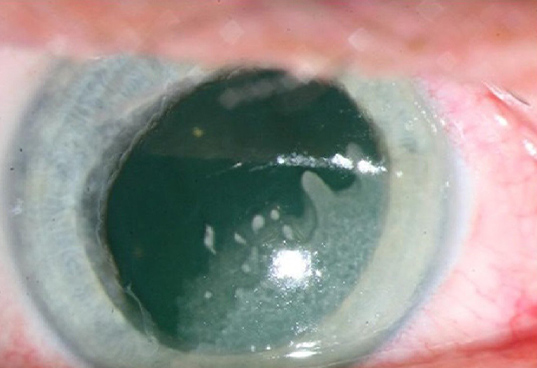
One study, for example, reports the case of a 28-year-old man who suffered a chemical splash to the eye. After rinsing with a phosphate-containing solution, calcification developed on the cornea and persisted for more than a year after the accident, with no sign of healing (Figure 1) [5].

Figure 1 : Opacification blanche de la cornée dans la zone lésée (Schrage et al., 2019)

This observation suggests a link between the use of phosphate-containing solutions and the development of corneal calcifications following an eye injury.

A phenomenon confirmed experimentally

This phenomenon has also been studied in experimental models. Research carried out on rabbit corneas exposed to chemical agents has shown that rinsing with phosphate-containing solutions can lead to the formation of calcium phosphate deposits under controlled conditions. These results confirm the mechanism observed clinically, although they do not allow the frequency of this occurrence in practice to be determined precisely [4].

Why limit phosphate in decontamination solutions?

The inclusion of phosphate in a decontamination solution can lead to certain side effects. This is because phosphate is reactive and can interact with several elements involved in the splash [6,7].
In particular, it can interact with metals such as iron, aluminium, copper, zinc or manganese, but also with calcium and magnesium ions found in many industries, particularly in the construction sector. Calcium is the most well-documented case, particularly in products containing lime or cement, but other interactions may also occur.

Precipitation may thus occur with:

  • calcium ions (Ca²⁺);
  • iron ions (Fe²⁺, Fe³⁺);
  • aluminium ions (Al³⁺).
These interactions can lead to the formation of complexes or poorly soluble precipitates, such as metal phosphates or calcium and magnesium phosphates.

Furthermore, when the eye is injured, this reaction may also occur, as phosphate can react with calcium released from damaged tissues, tears and the aqueous humour.
As a result, the solution may become cloudy, lose stability, promote the formation of deposits or encrustations, and lead to the formation of insoluble residues on the surface of the eye during ocular decontamination.

This is why the DIPHOTERINE® solution does not contain phosphate, in accordance with EMA recommendations [2,3].

The efficacy of the DIPHOTERINE® solution
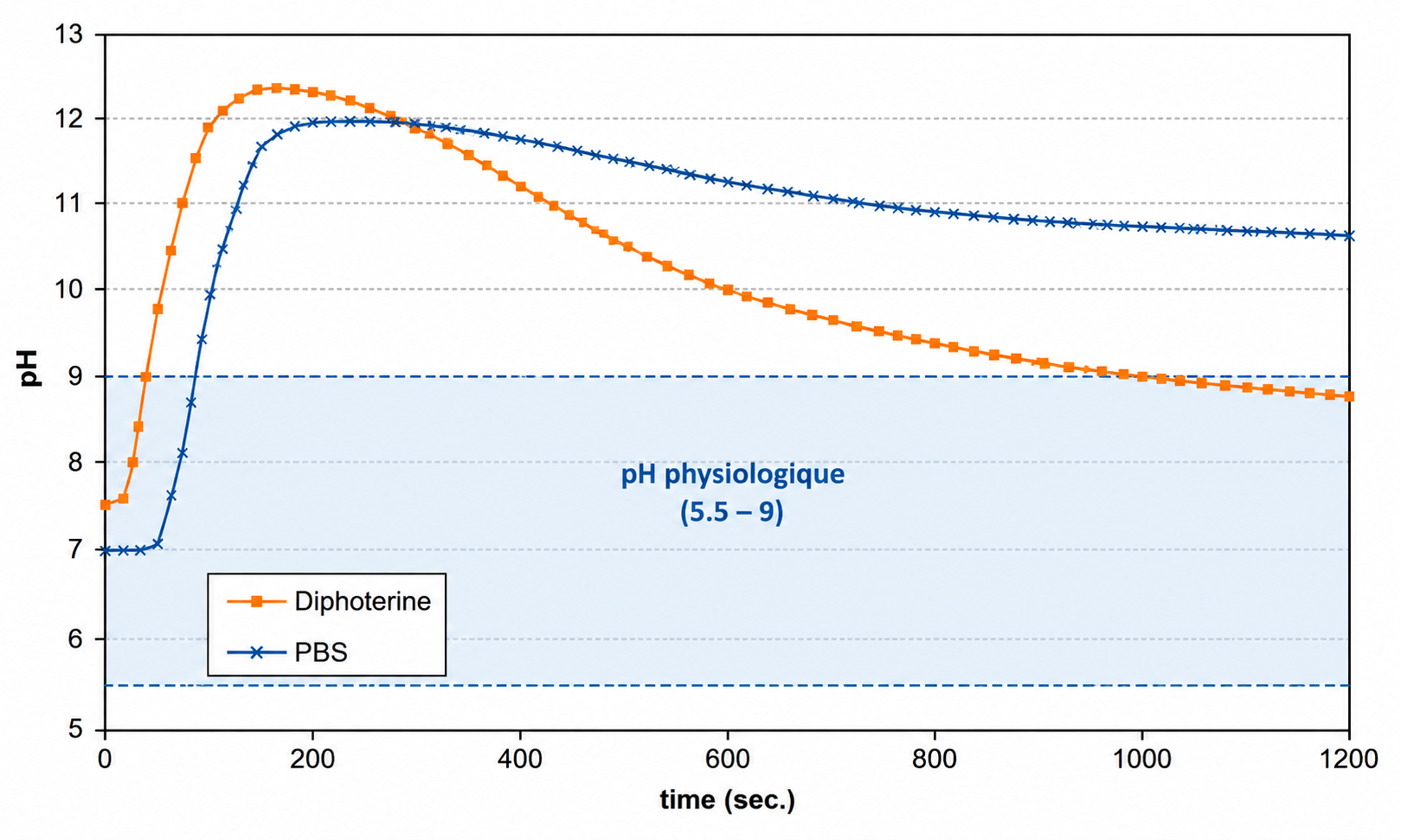
The efficacy of the DIPHOTERINE® solution and phosphate-buffered saline (PBS) was compared in an ex vivo experimental study conducted on rabbit eyes. Following exposure to caustic soda, the eyes were rinsed for 15 minutes with each solution, whilst the pH was continuously measured inside the eye.
After rinsing with the DIPHOTERINE® solution, the pH inside the eye returned to approximately 8.4, within the physiologically tolerable range, whereas with phosphate-buffered saline, the pH remained alkaline at approximately 11.7. The deviation from physiological pH is therefore approximately four times smaller after rinsing with DIPHOTERINE® than with phosphate buffer [8].

Adapted from Rihawi, Frentz and Schrage (2006). Changes in intraocular pH following exposure to caustic soda, followed by 15 minutes of rinsing with phosphate buffer (PBS) and the DIPHOTERINE® solution.

The DIPHOTERINE® solution has therefore proven its effectiveness in eye decontamination by lowering the pH to below 9, the threshold below which the risk of irreversible damage caused by alkalis is eliminated.

Conclusion

Solutions containing phosphates possess physicochemical properties that are useful in ophthalmology, particularly in helping to stabilise the pH.

However, in the event of a chemical accident, their use must be avoided due to the release of cellular calcium, which can lead to corneal calcification. This is even more serious as it is often difficult to determine immediately whether the cornea remains intact or not.

This is why the DIPHOTERINE® solution has been developed without phosphate, so that it can be used in the event of chemical contamination, whether the cornea is intact or damaged.

References Consulted

[1] L G Carney, T F Mauger, R M Hill; Buffering in human tears: pH responses to acid and base challenge.
Invest. Ophthalmol. Vis. Sci. 1989;30(4):747-754.
[2] European Medicines Agency (EMA). Questions and answers on the use of phosphates in eye drops.
EMA/CHMP/753373/2012. London: European Medicines Agency; 2012.
[3] European Medicines Agency (EMA), Information for the package leaflet regarding phosphates used as excipients in eye drops, EMA/CHMP/632775/2016, 2017.
[4] Kompa S, Redbrake C, Dunkel B, Weber A, Schrage N. Corneal calcification after chemical eye burns caused by eye drops containing phosphate buffer. Burns. 2006 Sep;32(6):744-7. doi: 10.1016/j.burns.2006.01.003. Epub 2006 Jul 10. PMID: 16835011.
[5] Schrage NF, Abu SS, Hermanns L, Panfil C, Dutescu RM. Irrigation with phosphate-buffered saline causes corneal calcification during treatment of ocular burns. Burns. 2019 Dec;45(8):1871-1879. doi: 10.1016/j.burns.2019.04.022. Epub 2019 Oct 16. PMID: 31629617.
[6] Lindsay, W.L., Vlek, P.L.G. and Chien, S.H. (1989). Phosphate Minerals. In Minerals in Soil Environments (eds J.B. Dixon and S.B. Weed). https://doi.org/10.2136/sssabookser1.2ed.c22.
[7] House, W. A. (1999). The Physico-Chemical Conditions for the Precipitation of Phosphate with Calcium. Environmental Technology, 20(7), 727–733. https://doi.org/10.1080/09593332008616867.
[8] Rihawi, S., Frentz, M. & Schrage, N.F. Emergency treatment of eye burns: which rinsing solution should we choose?. Graefe's Arch Clin Exp Ophthalmo 244, 845–854 (2006). https://doi.org/10.1007/s00417-005-0034-3.

crossmenu