Mechanism of the chemical burn and creation of the chemical injury
What is a chemical lesion?
A chemical lesion is the local result of the reaction of corrosive or irritant chemical products that react with biological tissues. This is the external injury caused to the body by the chemical..
The chemical lesion is characterised by partial or total destruction of the biological tissues..
The chemical product reacts with a chemical component of the tissue (a molecule, a cell or a protein…). This reaction destroys the tissue’s biological equilibrium. Modification of the tissue subsequently causes the macroscopic lesion observed. The severity of the lesion is proportional to the amount of tissue destruction: the severity of the chemical lesion is basically related to the type of product, the nature of the tissue involved and the area affected.
The skin, eye and digestive or respiratory tracts are in direct contact with the outside of the body and are therefore the primary targets of chemical products. Chemical lesions designate injuries inflicted by contact between chemical products and these specific tissues.
The chemical lesion may also be accompanied by other systemic symptoms.
When the chemical product causing the chemical lesion is toxic or harmful and passes into the body, reaching the organs or the bloodstream, it may interact with other biological targets.
Benzene for instance is irritant to the skin and eyes. It is a carcinogenic and mutagenic product: it may thus become interposed in the DNA chains and disrupt cell division. It may also lead to cell destruction (aplasia) or proliferation of the cells in haematogenous bone marrow (the organ producing the precursors of the blood cells). This may cause leukaemia.


Which chemical products cause a chemical lesion?
The chemical products that may cause a chemical lesion are categorised according to the seriousness of the lesions that they may induce: they are corrosive or irritant.
A chemical product is classified among corrosive or irritant agents when it is capable of reacting with biochemical components of the cells and the tissues of the skin, the eye and the respiratory or digestive tracts. The CLP/GHS regulations of the European Chemicals Agency provide the following definitions of corrosive or irritant products (CLP page L 353/87)
- Skin corrosion means the production of irreversible damage to the skin; namely, visible necrosis through the epidermis and into the dermis, following the application of a test substance for up to 4 hours.
- The reversibility of the skin lesions is to be considered in assessing the irritant nature of a substance.
- It is corrosive when it causes a severe lesion. Corrosive products cause destruction of the tissues with which they come into contact.
- If it only causes irritation, redness or inflammation, it will be considered irritant..
- The same chemical product may be corrosive or only irritant depending on the circumstances:
- If present in a mixture or on its own
- Depending on its concentration
- Depending on the environment in which it is present
- The hazard that a chemical product represents is indicated on its label by the manufacturer according to the regulatory obligations of the European Chemicals Agency.
For example: hydrochloric acid, HCl (commonly used as a descaling agent).
Hydrochloric acid is available commercially in the form of an aqueous solution.
According to the European recommendations, aqueous solutions of hydrochloric acid are classified as corrosive if their HCl concentration exceeds 25% and irritant if their HCl concentration is between 10 and 25%..
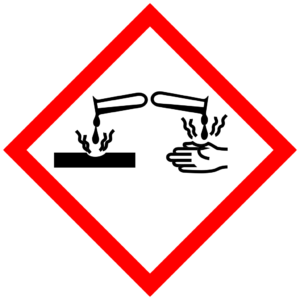
H335: May cause respiratory irritation
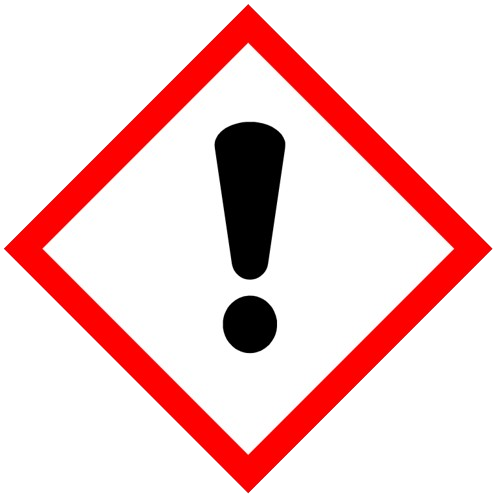
H319: Causes severe eye irritation
H335: May cause respiratory irritation
What is the mechanism of a chemical lesion?
It all begins with a chemical reaction between two molecules. On a microscopic level, the chemical lesion results from a chemical reaction between an aggressive chemical product and a biological constituent.
This reaction destroys the biological constituent and hence the tissue. This forms the chemical lesion.
The mechanism involved in development of the lesion depends on many parameters, the most significant of which is the nature of the reaction initiated.
Depending on its type, each chemical product will react with a different component of the biological tissue by means of one of following actions:
- Acid-base reaction: H+ proton exchange reaction between an acid and an alkali
- Redox reaction: electron exchange reaction between an oxidising agent and a reducing agent
- Chelation or formation of a complex from two molecules
- Solvation: dissolution of a chemical species in a solvent.
Examples:
- Acid-base reaction between the OH– ions of caustic soda and the ester bonds of fats.
- Solvation of the lipids of the cell membranes by hydrophobic solvents (diesel oil, toluene)
- Chelation of the Ca2+ calcium ions contained in the cells by F– fluoride ions (originating for example from hydrofluoric acid HF).
There are as many reactions that may cause chemical lesions as pairs of aggressive chemical product/biological target.
Stages of development of a chemical lesion
The mechanism of development of the burn may be divided into three phases:
- The contact between the chemical product and the tissue
- The penetration of the chemical product into the tissue
- The chemical reaction between the product and the biological component of the tissue
Skin or eye contact occurs when the chemical product is splashed on the skin or in the eye. Contact with the digestive tract (mouth, oesophagus, stomach…) occurs when the chemical product is swallowed. In the case of the airways, it takes place when vapours of the chemical product are inhaled.
Once the product comes into contact with the tissue, it may penetrate into it despite biological barriers. The chemical properties of the substance determine its potential and rate of penetration through the tissue.
Examples:
- A solid chemical product cannot readily penetrate through the skin.
- A small chemical molecule generally penetrates more quickly than a large molecule.
- A molecule penetrates more readily if it is lipophilic.
The chemical product will penetrate into tissue until it encounters a biological constituent with which it can react. The penetration depth of the chemical product into the tissue before it reacts therefore depends on its type
The chemical product is subsequently able to react with its biological target.
Once the chemical product has reached the biological constituent of the target tissue, the chemical reaction takes place. The biological equilibrium is changed, the tissue is locally destroyed and the lesion forms.
The lesion therefore only develops during the chemical reaction, once the chemical product has reached its target. Each splash of chemical product contains a very large number of molecules capable of reacting with a target molecule or with a target cell of the human body. The lesion progresses in this manner for as long as any chemical product still remains in contact with the tissue and has not yet reacted..
A rapid intervention following contact makes it possible to restrict the extent of the lesion: emergency contamination is paramount.
Factors that worsen the lesion
The type, depth and severity of the lesion depend on many factors:
- The nature of the aggressive chemical product
- Its concentration
- The contact time between the tissue and the chemical product
- The temperature of the chemical product and the pressure
The chemical products will react with different biological targets, depending on their type.Each reaction will have different microscopic repercussions on the cells, thereby causing macroscopic lesions that will not have the same characteristics
Example:
An acid will react with proteins and cause their coagulation whereas an alkali will dissolve the cells through saponification of the fatty acids of the cytoplasmic membranes and cause liquefactive necroses of the tissues.
The form in which the chemical product occurs and particularly its concentration are decisive parameters in development of the lesion. The concentration of the chemical product determines the quantity of aggressive molecules which it contains in a given volume of product. The higher the concentration of the product, the more aggressive molecules it will contain. A more concentrated chemical product will cause lesions that are more serious.
Aqueous solutions of hydrochloric acid for instance are classified as corrosive if their HCl concentration exceeds 25% and are only irritant if their HCl concentration is between 10 and 25%.
The contact time between the tissue and the chemical product is decisive. The chemical product present on the surface of the skin and of the eye will penetrate into the tissue and react gradually. The greater the contact time between the tissue and the chemical product, the greater the quantity of chemical product that will be capable of reacting and the more serious the lesion.
Account must also be taken of the temperature of the aggressive chemical product and the pressure at which projection occurs, as they will have an effect on the penetration rate and reaction rate. A hot chemical product reacts more readily than a cold product, since it has greater energy.
Why talk about a chemical lesion rather than a burn?
Chemical lesion or chemical burn? Lesions on the human body caused by chemical products are very different from thermal burns. The mechanisms of development of these injuries are different: mere heat transfer is involved in the case of a thermal burn – a chemical reaction in the other case. The cicatrisation periods of both these types of lesion are variable. The semantic distinction is therefore also necessary.
For more information, read the following article: “Why speak about “chemical injuries” rather than “chemical burns”
Secondary treatment and caring for a chemical lesion:
Chemical lesions may require secondary treatments and management by a physician. These treatments must be adapted to the specific hazard of each chemical product and to the severity of the lesion.
During human exposure to a chemical product, first aid involves washing.
Once decontamination as part of first aid is completed and has been effective, the chemical lesion no longer progresses. It is then possible to treat the established damage in order to facilitate cicatrisation.
If the chemical product is toxic, this hazard can now be dealt with.
The secondary treatment must be appropriate:
- It must be specific to the chemical product involved
- It must be scaled depending on the lesion developed
- Chemical lesions are conventionally managed in hospital burn treatment centres. The treatment is often similar to that required in case of thermal burns, with a few differences.
- Cicatrisation takes longer
- Skin grafts take less easily on chemical burns than on thermal burns
For further information concerning the treatment adapted to each chemical product: refer to list of tested products
Why rinse and decontaminate a chemical burn injury?
Corrosive and irritant chemical products react with the biological components of the skin or eye. This gives rise to skin or eye lesions or burns, the consequences of which may be very serious.
In the event of contact between a corrosive or irritant chemical product and the skin or eye, it is essential to limit the reactions between these products and the tissues. The chemical product will react with the tissue for as long as it is in contact with the latter and no action halts its aggressiveness.
In order to decontaminate effectively, the contact time and the reactions between the aggressive chemical product and the biological tissue must be restricted.
To this end, it is necessary to:
- Eliminate the chemical product present on the surface of the skin or the eye
- Halt penetration of the chemical product inside the tissue and remove the chemical product that has already penetrated
- Limit the corrosive or irritant potential of the chemical product in order to prevent development of lesions.
One must therefore act as quickly as possible and move the chemical product away from its biological targets.
Hence, emergency management requires one to:
- Undress the affected person. If the product has splashed on clothing, the latter will be soaked with corrosive or irritant agent which is liable to react if in contact with the skin.
- Perform thorough rinsing, which will allow mechanical removal of the chemical product from the surface of the body and dilute it, thereby making it less aggressive. A potential chemical action of the rinsing solution may also halt the aggressiveness of the chemical product, thereby limiting the lesions that it causes on the tissues.
Quick and thorough washing therefore allows effective decontamination of the tissues which have been brought into contact with a hazardous chemical product.
What are the advantages and limitations of rinsing with water?
“Wash thoroughly with water”. This recommendation for decontamination of chemical splashes is historical and still remains widespread. Nevertheless, washing a splash of chemical product with water has advantages and disadvantages.
It is the first solution offered for emergency decontamination of tissues brought into contact with a chemical product.
Rinsing with water has practical advantages which are often put forward: its availability and versatility. Access to water is indeed generally easy. Furthermore, it allows the vast majority of chemical products to be rinsed off with the same efficacy.
The action of the water on a splash of chemical product is mechanical: the water will rinse off the chemical product and remove it from the surface of the skin or the eye. This mechanical action is the main effect of the rinsing.
Furthermore, rinsing with a copious amount of water will allow dilution of the chemical product. The less the chemical product is concentrated, the less it is aggressive to biological tissues.
Rinsing with water however has a limited action and offers a number of disadvantages..
Rinsing with water encourages penetration of the chemical product inside the tissues.. En effet, l’eau a une pression osmotique inférieure à celle de la peau ou de l’œil. Ainsi, une partie de l’eau utilisée pour le lavage va pénétrer à l’intérieur du tissu et entrainer avec elle un peu de produit chimique. Le produit chimique qui aura pénétré pourra ensuite réagir avec les tissus et créer des lésions et des brûlures. Cette action est appelée « Effet Wash-In » [1]
Rinsing with water does not have any effect on the chemical product that has already penetrated into the tissues.Water does not make it possible to eliminate the chemical product that has already passed into the skin or the eye. The quantity of corrosive or irritant product that has penetrated will be able to react with its biological targets and cause chemical lesions. Consequently, if the chemical product has disrupted physiological balance, rinsing with water will not help to restore a physiological state. For instance, an acid that penetrates into the skin will reduce the pH of the skin that it contaminates. Rinsing with water will not allow a return to a normal pH for the skin.
Water does not have any chemical action on the reactivity of the chemical product.Rinsing with water does not allow any reduction in the hazard represented by the chemical product.
In order to obtain an optimum result, the intervention period for rinsing with water is very shortIn the United States, the norm of the American National Standard Institute (ANSI) recommends beginning rinsing within the 10 seconds following a splash of chemical product into the eye.
Finally, rinsing with water makes it possible to:
- Rinse the chemical product mechanically from the tissue surface
- Dilute it
Experimental studies showed that rinsing with water was not optimum and that it was possible to improve emergency management of a chemical burn, particularly for corrosive and irritant products.[2]