The danger of hydrofluoric acid (HF)
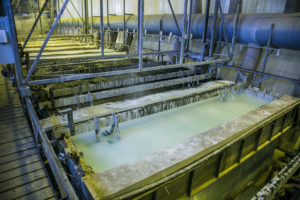
Hydrofluoric acid is a key chemical in many industries, particularly as a surface treatment agent (glass, metals, ceramics, etc.) or as a reaction additive. It is used in many fields of activity, from the production of photovoltaic cells to industrial maintenance in the food industry. Despite the dangers associated with its use, there are few or no substitute products or techniques. This is why its production is growing along with its global demand.
Why are fluoride ions in acidic environment as dangerous as hydrofluoric acid ?
Like the hydrofluoric acid (HF), the fluorides in acidic environment generate a dual action which is both:
- corrosive because of the H+ ions of the acid;
- and toxic because of the fluoride ions F– which, thanks to the destruction of the superficial layer of skin or eye, can penetrate deeply, chelate calcium and magnesium, and thus disrupt the biological balances. This results in very severe necrosis and in disruptions of the various turnovers.
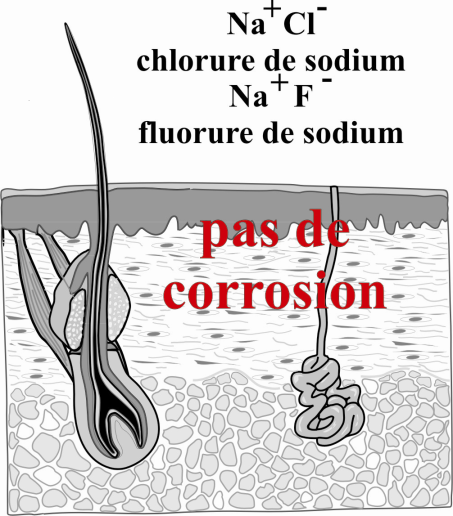
The destructive action of the acid mainly targets the superficial layers, whereas the fluoride ion does not damage them that much[1]. Then the devastation of these layers allows the HF and the fluoride ions that HF progressively releases to penetrate and to spread into the deepest tissues, resulting in liquefactive necrosis. This specific mechanism differentiates HF from other acids and particularly from strong acids which cause coagulation necrosis with precipitation of the tissular proteins[2].
Please remember : The HF hazard is due to the double presence of H+ and F– in an acidic medium. Any acid can release H+ into the medium – any fluoride can release F–
In the equilibrium HF H+ + F–, the first entity to be consumed is H+.
The more acidic the medium is, the higher the concentration in acid (meaning the concentration in H+) will be in the mixture, and the more the fluoride ions will be released and the more they will be able to react (Le Chatelier’s Principle).
This is the reason why the chemical substances derived from hydrofluoric acid have a specific classification, with more strict regulations for very toxic products, because there is still a HF hazard even for low concentrations.
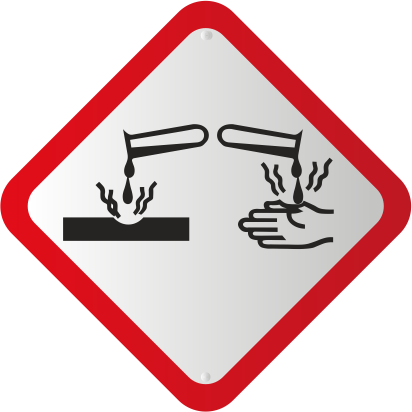

H310 Fatal in contact with skin
H300 Fatal if swallowed
H314 Causes severe skin burns
and eye damage
H310 Fatal in contact with skin
H300 Fatal if swallowed
H314 Causes severe skin burns
and eye damage
H310 Fatal in contact with skin
H301 Toxic if swallowed
H314 Causes severe skin burns
and eye damage
H310 Fatal in contact with skin
H301 Toxic if swallowed
H314 Causes severe skin burns
and eye damage
H311 Toxic in contact with skin
H301 Toxic if swallowed
H314 Causes severe skin burns
and eye damage
H301 Toxic if swallowed
H314 Causes severe skin burns
and eye damage
H302 Harmful if swallowed
H314 Causes severe skin burns
and eye damage
H302 Harmful if swallowed
H319 Causes serious eye irritation

H302 Harmful if swallowed
H319 Causes serious eye irritation
What is a fluoride in acidic medium ?
It is no more than the presence of H+ and F– ions in the same solution.
For instance, if you mix a strong diacid, such as sulfuric acid H2SO4, with some sodium fluoride, NaF:
- H2SO4 dissociates in water completely and releases 2 H+
- NaF is a salt which hydrolizes completely too if the solution is not saturated.
NaF <-> Na+ + F–
For instance, in bath containing 20% of sulfuric acid, 40% of sodium fluoride and 40% of water, you will find 40% of H+ ions and 40% of released F– ions.
Besides, this kind of property is currently used in chemistry to increase the power of chemical stripping.
The hydrofluoric acid is commonly used in the stripping of stainless parts.
Nitrofluoric mixtures, which correspond to a mixture of nitric acid (HNO3) and hydrofluoric acid (HF), can also be used.
Examples of such mixtures commonly used as stripping solutions:
HF 6 % / HNO3 15 % – Mélange à pH = 1
A mixture HF/HNO3/H2SO4 at pH = 1
Therefore the medium will be very acidic: with both H+ ions released by HNO3 (and H2SO4, when present in solution) and fluorides in the form of F– or HF.
Please remember : Mixing HF with a strong acid causes a rapid acid burn and thus builds the “entry route” for fluorides, although their “number” is theoretically lower than the number of H+.
How should fluorides in acidic medium be washed ?
Answer: fluorides in acidic medium should be washed like a hydrofluoric acid splash.
For the best results, this is how to achieve an active and efficient washing:
- Take action as early as possible in order to avoid the appearance of the first lesions
- Act on the H+ ions and, at the same time+;
- Chelate the fluoride ions F–
The washing devices using the HEXAFLUORINE® solution match those requirements because of being directly available at the workstation and transportable. The HEXAFLUORINE® solution acts on the acid and chelates the fluorides. Its hypertonicity allows to remove the chemical aggressor out of the tissues of the eye or skin (phenomenon of osmosis) and thus limits the penetration of HF and its action on tissues.. Please remember using an active solution such as HEXAFLUORINE® solution , immédiatement après la projection, permet d’éviter ou de diminuer la pénétration et l’action de l’HF sur les tissus, limitant ainsi le développement de la brûlure et les complications associées. Lors d’un lavage tardif ou insuffisant, un soin secondaire spécifique type gluconate de calcium peut être appliqué, selon le protocole du médecin responsable. Exemples de fluorures en milieu acide : Les mélanges fluonitriques :
- HF 6 % / HNO3 15 % – Mélange à pH = 1
- HF 3 % / HNO3 15 %
- A mixture HF/HNO3/H2SO4 at pH = 1
- Mixture /HNO3/H2SO4/NaF or HNO3/NaF
Other acids likely to release ions F– :
- BF3 (boron trifluoride)
- H2SiF6 (fluorosilicic acid)
- SiF4 (silicon tetrafluoride)
[1]: McCulley JP., Whiting DW., Petitt MG., Lauber SE, Hydrofluoric acid burns of the eye., J Occup Med. 1983, 25, 447-50.
[2]: Dibbell DG., Iverson RE., Jones W., Laub DR., Madison MS., Hydrofluoric acid burns of the hand., J Bone Joint Surg Am. 1970 Jul;52(5):931-6. Classification Labelling Packaging – European regulation 1272/2008