Exposure to chemical risks in the meat industry
The meat industry comprises all of the agri-food industrial activities specialising in the processing of farm animals for human consumption. Slaughterhouses perform the second stage of livestock processing, i.e. slaughtering the animals and preparing the carcasses.
There are three main types of meat that play an important role in the global meat industry market:
- Pork
- Poultry
- Cattle (beef and veal)
Of course, other animals are processed in slaughterhouses, but for the most part, they represent a small percentage of the current meat industry market. Following significant global growth in 2021, slaughterhouses are currently experiencing a decline in production, despite the continued increase in consumption. Globally, pig slaughtering has fallen by 9% and both chicken and cattle slaughtering have fallen by 2%. Nevertheless, the global meat market is doing well overall and is expected to grow by +7% between 2021 and 2025.
However, this fall in production is linked to various issues such as economic difficulties, strong competition and the large wave of departures mainly due to working conditions that discourage operators. The latter are faced with and overexposed to the risks of occupational diseases or accidents (OD/OA) every day. Among the most significant accidents are chemical burns, which account for 20% of the accidents recorded in slaughterhouses, just below accidents related to machinery use and muscular disorders. The frequency and severity of workplace accidents are higher than the occupational average and therefore increase the rate of absenteeism and early fatigue.
These accidents are mainly caused by the high workload and work rate in the slaughter sector. This leads many companies to use foreign workers who do not speak the local language, which makes it more difficult to ensure compliance with sector-specific rules and makes it necessary to readapt the training for risky jobs.
1. CULLING PROCESS
As mentioned, regulations in the slaughterhouse sector are very strict and place particular emphasis on hygiene. In order to keep the premises and materials clean, chemicals and optimal maintenance operations are required. Production area maintenance is a crucial step in the animal cutting process. There is an extremely high risk of transmitting disease from the animals or germs, called zoonosis, which can affect employee health.
1.1. MAINTAINING HYGIENE AND PREVENTING CONTAMINATION
Within this sector, it is very important that operators ensure hygiene and cleanliness by complying with and carrying out the following:
a. Wearing PPE
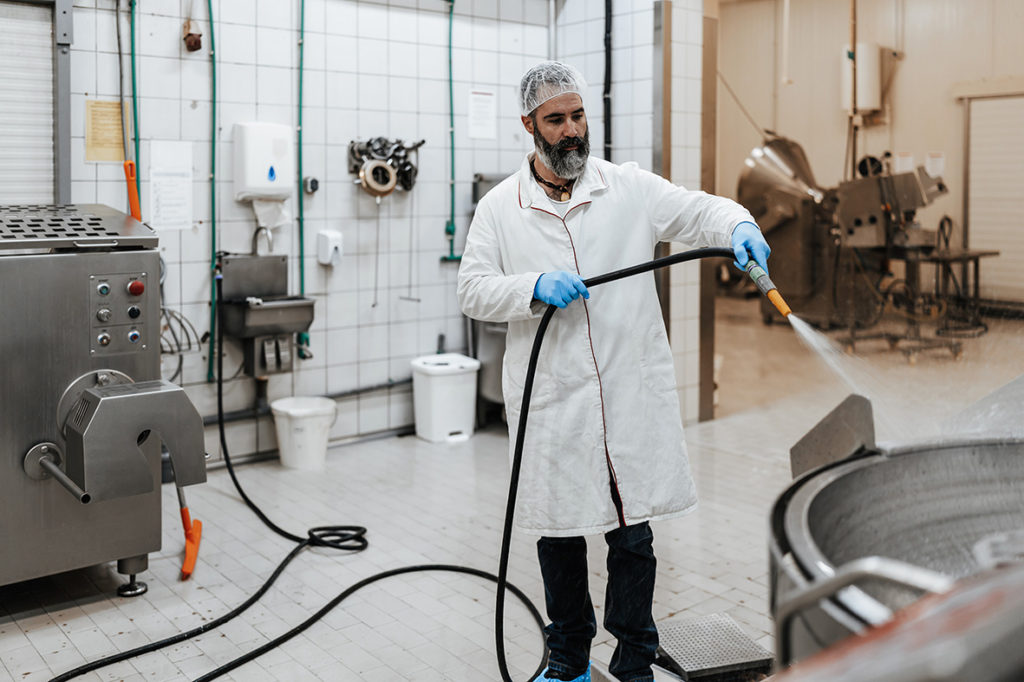
b. Regular hand washing (washing stations near each work area + hoses)
c. The use of detergents and disinfectants: they must all be chlorine-based. Chlorine is a toxic substance that must be used with care to avoid any kind of lung damage.
d. The use of hot water (ideally between 55 – 70°C)
e. The use of biocides: the majority of these products are hydrogen peroxide- or peracetic acid-based. Both of these chemicals are corrosive and can cause injury if in contact with the skin.
The premises and materials are maintained by the internal teams, but may also be maintained by external teams disinfecting and thoroughly cleaning the areas. For the majority of teams, whether internal or external, the premises are cleaned primarily at night.
1.2. DIFFICULTIES IN MAINTAINING HYGIENIC CONDITIONS
There are two main causes of accidents related to chemical burns:
➣ Careless handling of chemicals
➣ Fatigue due to workload and/or long working hours
As a result, there are three factors that make it very difficult to maintain hygienic conditions in a slaughterhouse environment:
- Wearing PPE: as in many sectors, the use of protective equipment is sometimes neglected. However, in slaughterhouses, accidents can happen very quickly, including chemical accidents. Forgetting to wear gloves or protective glasses can easily lead to irreversible injuries.
- Night-time cleaning: the premises and materials in large slaughterhouses are disinfected and cleaned at night. It is clear that night staff have a higher accident risk than day staff. For example, when cleaning materials, they are initially washed with a chemical product such as caustic soda.This is placed on the machines for a few minutes, so it is possible to switch on a machine without remembering to rinse it first, which can cause a chemical splash. It is true that chemical accidents are not as common as muscular disorders or accidents related to the use of machines, but it is important to note that the consequences are serious and can lead to irreversible damage.
- Adherence to the chemical use protocol: Chemical protocols are often overlooked due to a lack of consideration for the danger of chemicals.
1.3. THE PRINCIPLE OF “MOVING FORWARD”
The concept of “moving forward” is a key principle that advocates for organisations that meet the requirements of Regulation (EC) 852/2004. This principle is reflected in the movement of the animals, from the stables to storing the meat, known as carcasses, and includes the notion of moving forward through the stages without going backwards. As a result, the dirty areas, located at the back of the main building, are well identified and demarcated. This makes it possible to separate the clean and dirty areas.
Cleaning must be carried out at each completed stage as per a certain protocol. The animal’s processing route is listed below in order for us to understand the risks involved in certain stages of slaughter. These steps differ slightly from one animal to another (poultry, beef, pork, etc.), but there is a general process that is as follows:
I. Arrival and inspection
- This involves the arrival of the animals from the cattle truck and their inspection by the staff. The animals are then placed in the barn and their health checked by the State veterinary inspectors.
➣ Maintenance: The trucks that transported the animals and the bunkers are cleaned in two simple steps: disinfection and rinsing. A first surface clean is carried out with a Kärcher washer, and then thorough cleaning with octanoic acid and decanoic acid followed by a rinse with water. The first disinfectant is corrosive and the second irritant. Due to the use of hoses for disinfection and rinsing, chemical splashes can occur quickly.II. Bringing in, restraining and stunning
- Once the animals are brought to the slaughterhouse, they are restrained using equipment designed to immobilise them. The animals are then stunned with a bolt gun that triggers an immediate loss of consciousness.
III. Bleeding, skinning and head removal
- Once it is stunned and unconscious, the animal’s condition is checked. The animal is then lifted by one of its hind legs to enter the slaughter line. The operator proceeds to bleed the animal, emptying it of its blood. As soon as its death has been verified by the officer, the latter will separate the hide from the carcass, which is called skinning. Most of the parts removed are processed and assessed as heads, viscera and offal, which are checked for health compliance.
➣ Maintenance: The bleeding and skinning of the animal takes place in the stunning area. These areas are set up in such a way that the operators have quick and efficient access to a water station with a hose. This allows for quick washing between each processed animal.
The surface of this area is cleaned with caustic soda to remove any animal fat that has become embedded in the materials and surfaces of the area, followed by rinsing. In addition, the materials should be cleaned exclusively with hydrochloric acid. Both acids are known to be irritating and corrosive and should be used with care.IV. Splitting and blunting
- To facilitate health inspections and due to commercial constraints, the carcasses are split in two. Subsequently, to better display the carcass, the surface fat is removed and salvaged by other industries, such as the oil sector.
V. Weighing/Ranking/Marking
- Next, the State veterinary services have the task of inspecting the sanitary compliance of the carcass for commercial use. Finally, the carcasses are placed in cold storage to rest for a minimum of 24 hours. Depending on demand, the meat is delivered directly as carcasses, quarters or prepared and packed in trays.
➣ Maintenance: The meat is stored in cold rooms. These chambers maintain their temperature through the use of ammonia (NH3) in gaseous form. This is one of the main industrial refrigerants. It is classified as a toxic and flammable gas. It is highly corrosive to the skin, mucous membranes and eyes. In the event of a leak, it can create a potentially fatal accumulation of liquid in the lungs (pulmonary oedema) and thus cause death or at least a critical condition.
2. RISK AREAS
A. Storage areas
These different chemical substances, used as part of cleaning and preserving the meat, are kept in specific premises. These premises are obliged to report the dangers of using these products clearly and concisely. However, any lack of vigilance can lead to spills or chemical splashes. Therefore, it is important to take great care to avoid contact that could lead to a chemical burn.
B. Maintaining materials
Slaughterhouse machines are primarily made from stainless steel. Maintaining these requires passivation paste. This paste reinforces the strength of the pipe weld. It consists ofhydrofluoric acid (5-10% concentration) mixed with nitric acid (10-15% concentration).
Hydrofluoric acid removes contaminants while nitric acid helps activate the stainless-steel surface to encourage passivation. If contact is made with these passivation pastes, the operator may develop an injury. The concentration and body surface area affected will determine the severity of the side effects, namely heart rhythm disturbances, which may lead to cardiac arrest.
Unfortunately, the majority of operators are unaware of the composition or danger of these passivation pastes. Moreover, the late onset of burning sensations in the event of skin contact (except in cases involving high concentration products) does not help users to remain aware of these dangers.
C. Water treatment
Each slaughterhouse has its own water treatment site, due to the large amount of water used. These sites represent large risk areas due to the possibility of contact with products such as sulphuric or caustic acid, both of which are corrosive in nature. A splash can lead to irreversible damage.
3. PREVENTION AND DECONTAMINATION METHODS
Faced with this problem of lack of vigilance or attention and the risk of using chemical products, Prevor laboratories have provided an effective decontamination solution. An accident can happen quickly in the slaughter area as well as in the water storage or treatment area. The dangers are often hiding in various areas that, to the naked eye, may appear harmless in terms of chemical accidents.
Prevor’s mission is to renew an awareness of the dangers of chemical splashes by offering an active, hypertonic solution called DIPHOTERINE®. This solution is both amphoteric and a chelating agent, which means it can eliminate the chemical from the surface of the eye or skin, stop it from penetrating and, finally, extract it from the tissues if it has not yet reacted. It offers a more realistic response time of 60 seconds (unless LIS eye wash is used). In the case of delayed washing, i.e. washing after 60 seconds, DIPHOTERINE® solutions remain effective. Both prevent the lesion from developing further and thus reduce the damage caused.
When dealing with the use of hydrofluoric acid-based chemicals, Prevor offers HEXAFLUORINE® solution It is a washing solution that acts against splashes of hydrofluoric acid or fluoride in an acidic medium on the eye or the skin. It works in the same way as DIPHOTERINE® solution. HEXAFLUORINE® solution enables the immediate extraction of the hydrofluoric acid that has penetrated and provides a greater range of intervention when dealing with a product that can be lethal.
It is undeniable that slaughterhouses are not lacking in hazards, chemical accidents being one of them. These accidents, which are sometimes neglected, have serious consequences for the victims and the company. Popular decontamination solutions, such as rinsing with water, are passive solutions that are unable to effectively prevent a chemical injury.