Chemical risks in automotive industry
Pieces manufacturing
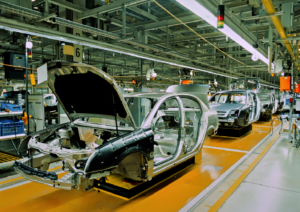
The manufacture of the pieces (engines, plastics, various elements of a car) requires the use of chemicals such as adhesives, acids, bases and cleaning chemicals, in plastics, in foams and surface treatment.
The manufacture of the pieces (engines, plastics, various elements of a car) requires the use of chemicals such as adhesives, acids, bases and cleaning chemicals, in plastics, in foams and surface treatment.
- Adhesives: there is a wide range of adhesives for attaching the pieces together or for maintaining the sealing of certain pieces. The adhesives are also used in body and painting workshops.
- Special chemicals: are used in various applications including products to remove paints, cleaner for paint booths, etc.
- Pieces and foams: a range of preformed pieces and pumpable foams for soundproofing foam, sticking, avoiding or minimizing vibrations and ensure the tightness of cars has been developed.
- Surface treatment: this part deals with the pretreatment of metals for applications in body and automotive assembly, with a range of cleaning, pretreatments and conversion coatings. The chemical pretreatments for light metals, plastics, glass and steel for the automotive industry are a reference for protection against corrosion, paint adhesion and environmental safety.
(For more information on surface treatment, please consult the article "Metallurgy")
Painting workshops
The bodies are also painted by the automotive companies. There are different ranges of colors and paints using organic solvents and isocyanates.
Organic solvents used for different tasks of preparation of surfaces, such as cleaning, degreasing and pickling can penetrate through the skin or the eyes, causing potential health risks.
Car manufacturers
Car manufacturers assemble the various elements of a car and add the liquid in the car in order for the mechanics to work properly such as:
- Corrosion inhibition liquids in cooling systems
- Engine coolant concentrates
- Heat transfer fluids and coolants
- Oil soluble colorants
- Colour markers for petroleum
- Hydraulic fluids
- Fuel additives – efficient and ecological
Chemical risk
In the different stages of the automotive industry, the most commonly used chemicals are acids, bases and solvents (mostly organic solvents). These products are corrosive or irritant. They are present at any concentration and in any quantity.
The risk zones are the production areas, the decanting areas, valves and pumps, and sometimes the open baths.
Moreover, all kinds of chemicals are handled in laboratories. There is thus a risk of projection and chemical spill..
In the surface treatment of metal parts, hydrofluoric acid can be used in large quantities, causing a high risk if there is a contact.