Thioglycolic acid :Understanding the risk of specific chemicals of interest
However, thioglycolic acid is still widely used in domestic products such as depilatory creams and by hairdressers for “perms”. Let’s understand the risk it presents.
Let's try to understand the risk it poses.
General Information
Thioglycolic acid is a colorless liquid with a strong, typical mercaptan disagreeable odor (although olfactory fatigue may occur)
Thioglycolic acid is used in cosmetic formulations as a ‘keratin structure modifier’ for perming or straightening products. It is also found in many depilatory cream formulations, in pharmaceutical production or manufacturing, and as a stabiliser for vinyl plastics.
It is now also used as a covering or stabilising agent for Cd/Te quantum microdots.
Thioglycolic acid belongs to the class of thioglycolates.
Other names for thioglycolic acid include:
- Mercaptoacetic acid
- Acetomercaptan
- 2-Mercaptoacetic acid
- 2-Thioglycolic acid
- Thioglycolic Acid
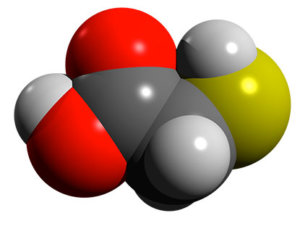
CAS 68-11-1; Molecular Formula HSCH2COOH
Thioglycolic acid is a reactive reducing agentit is readily oxidized on exposure to air. Thioglycolic acid is also a weak acid due to the presence of a carboxylic acid function in the molecule.
Because of its high reactivity, it is incompatible with air, strong oxidizers, bases, active metals such as sodium, potassium, magnesium, and calcium (for examples).
Thioglycolic acid is considered to be a Class IIIB Combustible Liquid, therefore, it is not considered to be flammable.
Eye/Skin Irritant/Corrosive – Skin Absorption Potential and Toxicity
Thioglycolic acid is a contact irritant or corrosive substance of the eyes, skin, and mucous membranes.
It is known to cause severe skin burns and eye damages. The European Chemical Agency (ECHA) recommends to label it with the H314 risk phrase. (full classification)
In case of cutaneous or ocular exposure to thioglycolic acid, corneal damage and chemical skin injury with blister formation has occurred.
Let’s take some examples of cases of human exposure and studies on animals that have been reported in the literature
- In one reported case where thioglycolic acid liquid was splashed into the eyes bilaterally and also on the skin of the face, legs, and arms, second-degree (blistering) injury of the skin areas occurred. By two hours, the corneas were clouded (one worse than the other) and the conjunctiva was edematous. It took several months for the corneas and conjunctiva to heal, and some vascularization occurred resulting in mild visual impairment.
- Experimental animal studies have shown significant eye and skin lesions from direct contact. Additionally, the thioglycolates class has been shown to be rapidly absorbed through the skin in experimental animals, resulting in systemic toxicity.
- This is somewhat corroborated by a single case report of a 79-year-old woman who developed significant systemic toxicity including toxic pulmonary edema, and sequelae of hemorrhagic fibrinous tracheobronchitis, acute respiratory distress syndrome (ARDS), lactic acidosis, kidney and liver failure, rhabdomyolysis, and bleeding from the mucous membranes following exposure to a home permanent waving solution containing thioglycolic acid. This exposure, however, may have been primaryily by inhalation rather than dermal contact.
- Thioglycolic acid also presents liver and digestive tract toxicity when it is ingested.
As part of cosmetic formulations, thioglycolic acid has been associated with development of irritant or allergic contact dermatitis, particularly amongst hairdressers exposed chronically.
Chronic Effects/Carcinogenicity
Thioglycolic acid was not mutagenic in various Salmonella tyhrimurium strains with or without metabolic activation.
There is currently no evidence that thioglycolic acid is a carcinogen.
Regulatory/Advisories Issues
- France: an indicative professional threshold limit (TLV) value is given by the national institute for health and safety at work: 1 ppm over 8 hours
- US OSHA: no OSHA (US Occupational Health and Safety Administration) No Permissible Exposure Limit (PEL) has been established. (VLEP).
- US NIOSH: No Immediately Dangerous to Life or Health (IDLH) has been established. NIOSH recommended (REL) Time Weighted Average (TWA) the time-weighted exposure limit of 1 ppm (3.8mg/m3)
- US ACGIH: TLV/TWA of 1 ppm (3.8 mg/m3) with a notation for skin absorption. The time-weighted exposure limit of 1 ppm
Full Classification of thioglycolic acid by European Chemical Agency (ECHA)
References Consulted
- ACGIH. Thioglycolic acid, in: American Conference of Governmental Industrial Hygienists. Documentation of the Threshold Limit Values and Biological Exposure Indices, 7th ed, Cincinnati, OH, USA, 2001, 2pp.
- Anon. Final report on the safety assessment of ammonium and glyceral thiogycolates and thioglycolic acid. J Am Coll Toxicol 1991; 10(1):135-192.
- Burnett CL, Bergfeld WF, Belsito DV et al (Cosmetic Ingredient Review Expert Panel). Final amended report of the safety assessment of ammonium thioglycolate, butyl thioglycolate, calcium thioglycolate, ethanolamine thioglycolate, ethyl thioglycolate, glyceryl thioglycolate, isooctyl thioglycolate, isopropyl thioglycolate, magnesium thioglycolate, methyl thioglycolate, potassium thioglycolate, sodium thioglycolate, and thioglycolic acid. Int J Toxicol 2009; 28(4 suppl):68-133.
- Gan HF, Meng XS, Song CH, Li BX. A survey on health effects in a human population exposed to permanent-waving solution containing thioglycolic acid. J Occup Health 2003; 45(6):400-404.
- Hathaway GH, Proctor NH (eds). Thioglycolic acid, in: Proctor and Hughes’ Chemical Hazards of the Workplace, 5th ed. Wiley Interscience, Hoboken, NJ, 2004, pp. 673-674.
- HSDB. Mercaptoacetic acid, in: Hazardous Substances Data Bank, National Library of Medicine, Bethesda, MD, USA. NLM-NIH (Toxnet), accessed June 7, 2014.
- Mierer M. Peracute toxic edema of the lung with complete SIRS after inhalative exposure to thioglycolic acid as example for a chemically released, immunologically activated, mediator induced multiorgan failure. Intensivmedizen und Notfallmedizen 1996; 33(3):193-198.
- NIOSH: Thioglycolic acid, in: NIOSH Pocket Guide to Chemical Hazards, Department of Health and Human Services, Centers for Disease Control and Prevention, National Institute for Occupational Health and Safety, DHHS (NIOSH) Publication No. 2005-149, Cincinnati, OH, USA, 2007, p. 306.
- Peng JJ, Liu SP, Wang L, He YQ. Studying the interaction between Cd/Te quantum dots and Nile blue by absorption, fluorescence and resonance Rayleigh scattering spectra. Spectrochim Acta A Biomol Spectrosc 2010; 75(5):1571-1576.
- Valks R, Conde-Salazar L, Malfeito J, Ledo S. Contact dermatitis in hairdressers, 10 years later: patch-test results in 300 hairdressers (1994 to 2003) and comparison with previous study. Dermatitis 2005; 16(1):28-31.
- Information on chemicals
- INRS toxicological sheet on thioglycolic acid.
Alan H. Hall, M.D. President and Chief Medical Toxicologist
Toxicology Consulting and Medical Translating Services, Inc.
Laramie, Wyoming, USA
Clinical Assistant Professor
Colorado School of Public Health
University of Colorado-Denver
Denver, Colorado, USA