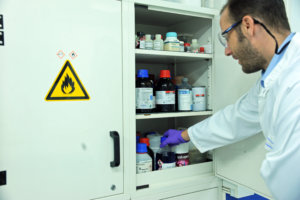
Laboratory – Storage of chemicals
Storage of many different chemicals in a laboratory setting is done following a few simple rules
- Store by chemical compatibility
- Use secondary containment
- Store the minimum quantity needed consistent with use requirements
The sorting of diverse chemicals found in laboratories by compatibility is often a difficult task. The safety data sheets may have some compatibility information, but this is frequently terse and difficult to interpret. The hazard classifications of the Global Harmonization System provides a starting point for setting up a storage compatibility program.
The following table lists the GHS-drived storage groups:
Storage groups according to GHS
Bases
Chemicals in the storage groups in section 1 may require dedicated safety cabinets, dedicated rooms, or possibly outside storage, depending on quantities and local ordinances.
Chemicals in the storage groups in section 2 may be stored together, but placed in dedicated secondary containment within that location.
Secondary containment can be a simple polyethylene tray of sufficient size to contain 100 percent of the contents of the largest container in the tray. These trays can also be used within safety cabinets to provide further segregation, if needed.
The nest method to limit the amount of chemicals in a laboratory is “just-in-time” delivery. This arrangement with a supplier uses a scheme such as “order before 10am, deliver by 3pm”.
In the absence of a just-in-time program, then ordering chemicals in the smallest size containers consistent with needs must suffice. While this may increase the cost per container, it will reduce waste disposal costs and may also make more laboratory space available for work, rather than storage.
To learn more
Neal Langerman