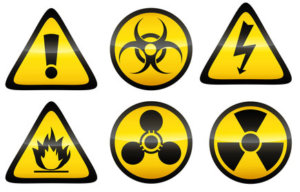
Chemical risks in chemical waste treatment
Waste are the result of the human activity and in particular its economic activities.
Industrial waste whose elimination legally falls to the producers, is distinguished from domestic waste by its origin and nature. The chemical risk will be linked to its physico-chemical and toxicological characteristics: explosive, flammable, combustive, irritant, corrosive, or toxic.
Special industrial waste or dangerous industrial waste
Because of its lower or higher concentration in noxious elements, it presents some hazards for the environment and the human health. The dangerous character is determined by a catalogue of hazardous properties and a list of components.
Its handling and treatment require particular precautions and specific means. With specific regard to the chemical waste, the following agents can be quoted: chemical solutions (organic or inorganic acids and bases, chlorinated or not chlorinated solvents) and special reagents and residues (peroxides, chlorinates and strong oxidizers).
Industrial waste treatment
The waste treatment is the operation which will enable to reduce its polluting potential as well as its volume. In certain cases, waste can undergo a pretreatment, operation which leads to the modification of its chemical composition or physical characteristics.
Employees can be confronted with any kind of occupational hazards and more particularly chemical ones: during the handling of the chemical waste itself during the phases of identification, collection, conditioning, storage and treatment as well as during the handling of reagents used for the treatment.
5 main types of treatments
- Physico-chemical treatment: dedicated to mineral waste. It will depend on the chemical composition of the waste (presence of cyanides, chromium plates, heavy metals, pH…). This waste is a more or less concentrated aqueous solution which can potentially contain various chemical agents : acids, bases, oxidizers, reducing agents, heavy metals compound. The physico-chemical treatment of a toxic effluent is a treatment which needs the intervention of chemical reactions between the substances contained in the effluent and the suitable chemical reagents. As examples, soda, hydrochloric acid, sulphuric acid, potassium permanganate, sodium sulphite or lime are used as treatment reagents.
- Incineration: only for organic waste. Usually, waste containing less than 2% of halogens (compounds containing chlorine molecules, bromine or sulphur) is distinguished from waste containing more than 2% of halogens.
- Biological treatment: for specific categories of organic waste.
- Storage: waste is stabilised and stored before hiding.
- Hiding: in case of absence of any existing treatment allowing to reduce the polluting potential of the waste.