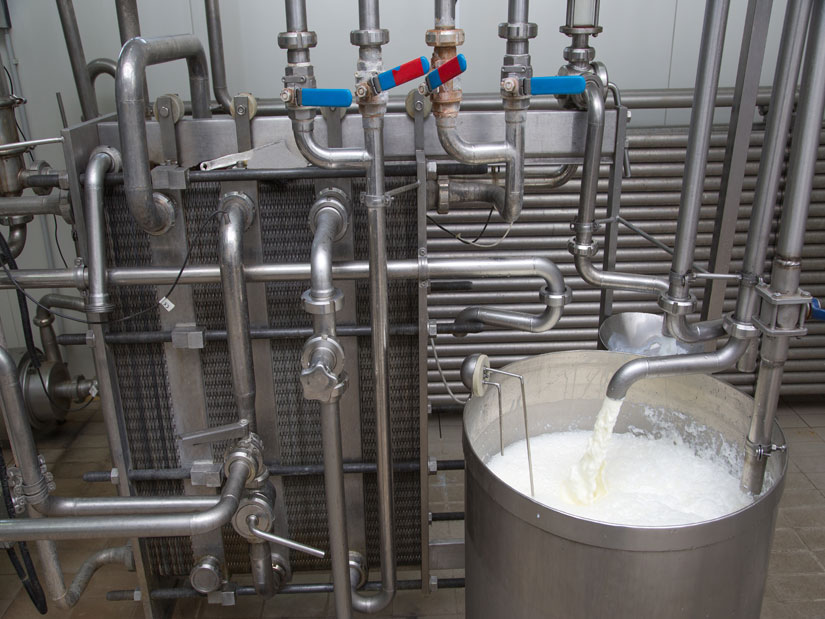
Food industry – Dairy products
Due to the various activities in the production of milk, cream and cheese, the staff is confronted with various chemical risks from the beginning to the end of the production chain.
- Opérations CIP (Cleaning In Place – Nettoyage en place)
Les tuyaux et les diffuseurs doivent être nettoyés entre les cycles pour qu’il n’y ait pas de résidus de la production précédente, pour cela il faut :
Un nettoyage alcalin (mélanges d’hydroxyde de sodium/hypochlorite de sodium, chlore)
Un nettoyage acide (acide phosphorique, acide nitrique, acide peracétique) - Maintenance
Tanks and trucks must be cleaned and livestock products must be free from bacteria or germs that could be harmful to humans. Before being placed in containers (stainless steel tanks), most containers must be cleaned with various chemicals such as alkaline products and acidic disinfectants (caustic soda, peracetic acid…).
In addition, the maintenance of stainless steel pipes involves the use of hydrofluoric acid-based products in the form of a liquid or pickling paste used after welding operations. - Waste water treatment
Milk production generates large quantities of “white water” residues that must be treated with large quantities of caustic soda and sulfuric acid. - Laboratories:
From raw materials to finished products, various tests are carried out and there are a large number of different chemicals, varying from low to high concentrations.
The employee must decontaminate themselves quickly, even if they cannot see or move. The pain associated with the contact of the chemical with the eye or skin is also a burden. It is necessary to act efficiently and quickly.
The employee needs to have an effective rinsing solution against all irritating or corrosive chemicals and an effective solution against hydrofluoric acid (HF).
Advantages of the Diphoterine® solution for this sector
- Unique protocol
- An effective solution against all types of chemical substances
- Wash anywhere
- Quick response
- Fast and serene reaction
- Relieves pain
- A reliable wash for any injuries
- The Hexafluorine® solution for the handling of HF splashes
Mobile solutions








Testimonials

Thanks to Diphoterine® solution, there were no sequela
- Carlos Arellanos, Occupational health physician, Solvay

Diphoterine® is more practical than water from a visibility point of view
- Annie Valorteaux, nurse

Diphoterine® is definitely quicker than water!
- Damien Poirot, Safety Officer

Chemical burns represent 10% of burns
- Jean-Luc Fortin

Those who are most exposed have Diphoterine® solution on their belts
- Hélène Duval, nurse at Smurfit

We must specify chemical burns because these burns are of another type
- Lucien Bodson, Anaesthetist

Diphoterine® solution is active, unlike water
- Mickael Dupont, QSE Manager

Diphoterine® solution helps workers
- Parag Kulkarni, doctor in India
Read our studies on solutions
Download all documents